
Executive summary
- There are significantly more school places than pupils in England, such that a quarter of schools face significant financial risks.
- The number of unoccupied places in England is forecast to continue to increase, which will further jeopardise the viability of a proportion of existing schools.
- In aggregate, the pupil forecasts of Local Education Authorities (LEAs) continue to over-estimate pupil numbers, such that funding is sought and often secured towards the delivery of even more school places that are not needed, which further undermines the viability of schools.
- It also means that financial contributions are often secured from developments that, in retrospect, are not necessary, and thereby unnecessarily further compromise the viability of residential development.
- New schools will still be needed in some locations, notwithstanding the overall national picture, but these will need to be located where they are strategically needed.
How has the sufficiency of school places changed in the recent past?
As illustrated in the following chart, the number of primary school pupils in England increased from 2009 to 2017 before levelling off and then declining. Unsurprisingly, this trend is reflected in the number of secondary school pupils circa 7 years later, rising from 2016 to 2024 before beginning to plateau. It should be expected that the number will similarly begin to tail off, as has happened with the number of primary school pupils.
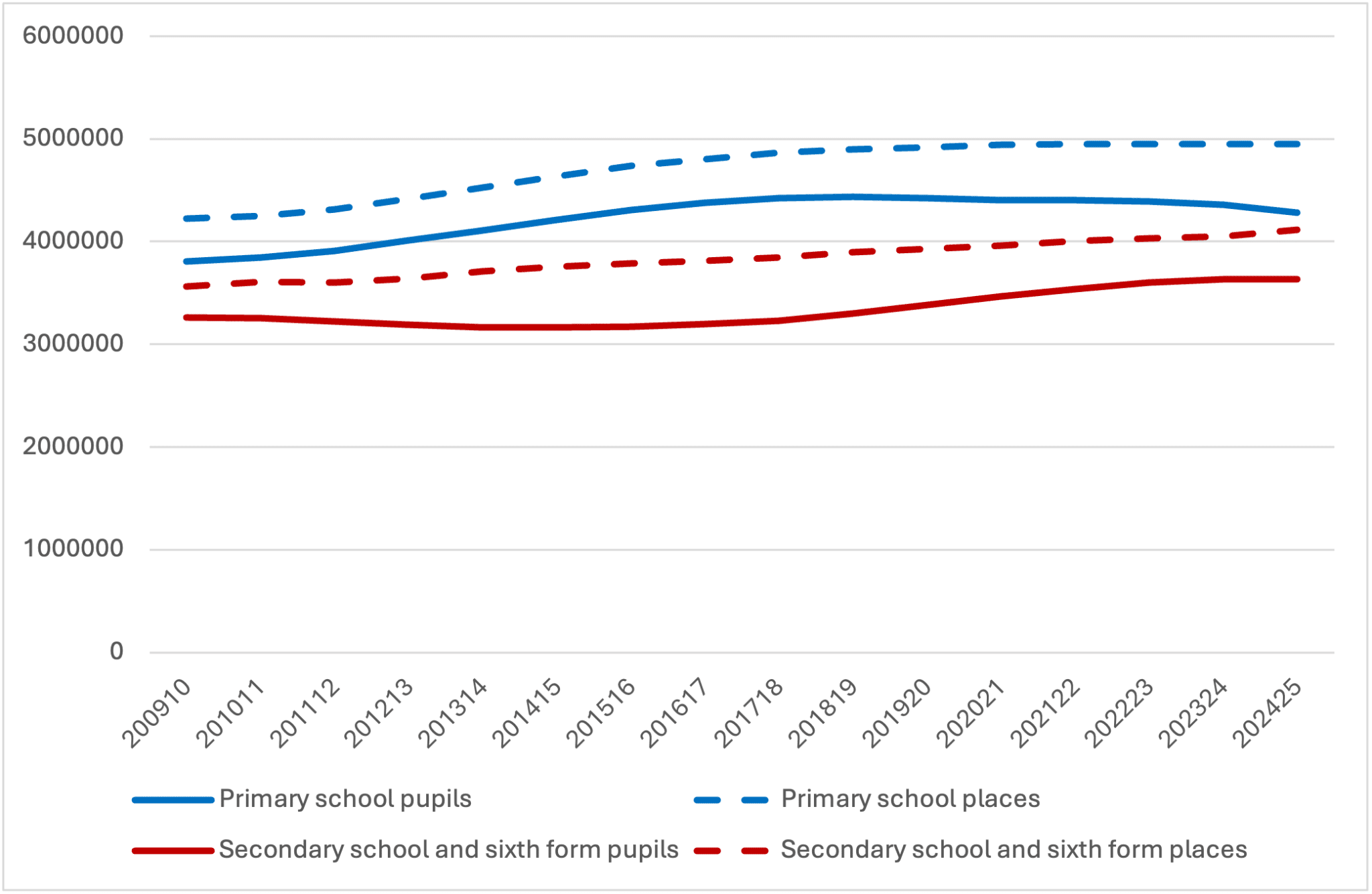
The preceding chart also illustrates that there has remained a significantly greater number of places than pupils in primary schools, secondary schools, and sixth forms. Indeed, across England, in 2024/25:
- There were 4.28 million primary school pupils in 4.95 million places in mainstream schools, which represents an occupancy rate of only 86.5%.
- There were 3.63 million secondary school and sixth form pupils in 4.12 million places in mainstream schools, which represents an occupancy rate of only 88.3%.
Therefore, there is already capacity to accommodate 668,000 more primary school pupils and 483,000 secondary and sixth forms pupils in existing schools nationally.
This under-occupation of schools presents a financial challenge, as funding is allocated by the DfE on the basis of the number of pupils rather than places. Indeed, the DfE suggest that a school would face significant financial risks with an occupancy rate of 77.5% or less in ‘Responding to Changing Demand for School Places’. In 2024/25, some 24.4% of schools already found themselves in this situation nationally.
The reasons for this include the fact that the number of primary school places has continued to increase broadly in accordance with the rates of growth of pupil numbers from 2009 to 2017. This is notwithstanding that the number of pupils has levelled off and started to reduce. Consequently, there is an ever-growing number of unoccupied primary school places nationally as illustrated in the following chart.
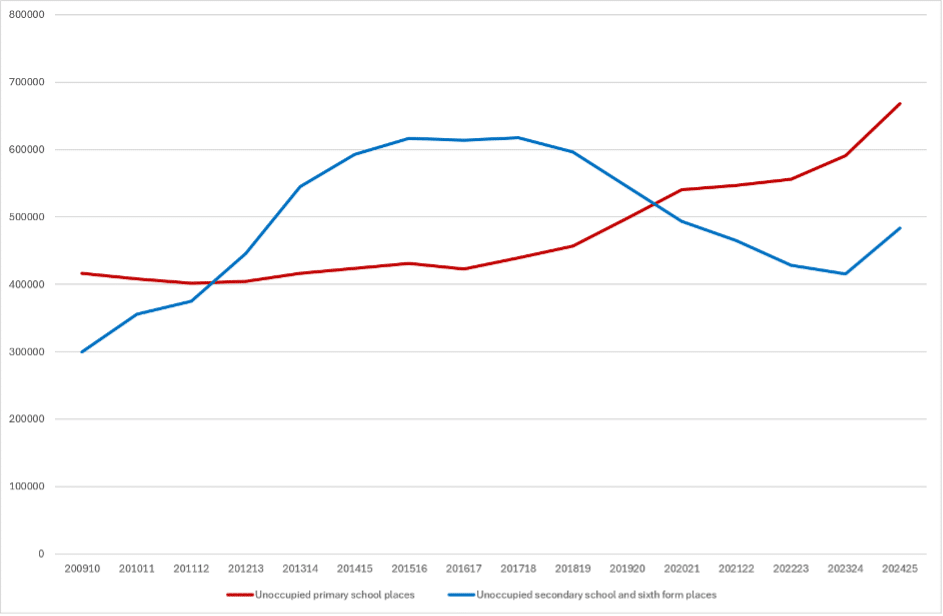
Similarly, as illustrated in the preceding chart and the following table, there has been a slight increase in the number of unoccupied secondary school places since 2023. This is likely to increase in the future, given the decreasing number of primary school pupils who will move into secondary schools.
 How is the forecast on sufficiency of school places expected to change in the coming years?

The DfE prepares national pupil forecasts, and local education authorities (LEAs) are also required to prepare such forecasts for their areas which can be aggregated to indicate the likely change at a national level. These both suggest that the number of pupils will reduce into the future across primary schools, as well as secondary schools and sixth form.
It is also evident that applying the rates of change of primary school pupil numbers which occurred 7 years previously to the number of secondary school pupils provides an accurate indication of the change in the number of pupils of secondary school pupils. Applying this approach again suggests that the number of secondary and sixth form pupils will reduce into the future.
Each of these respective forecasts are set out in the following charts.
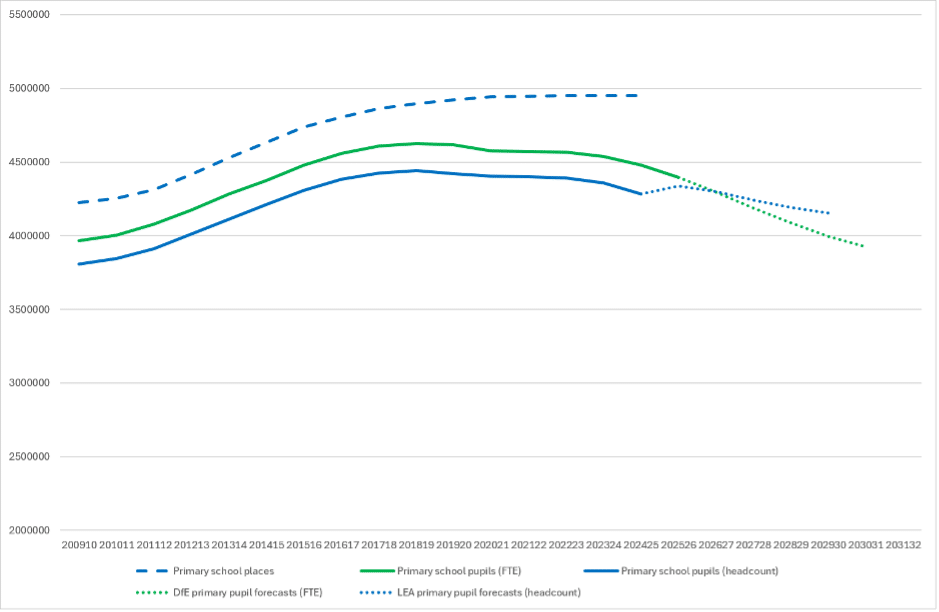
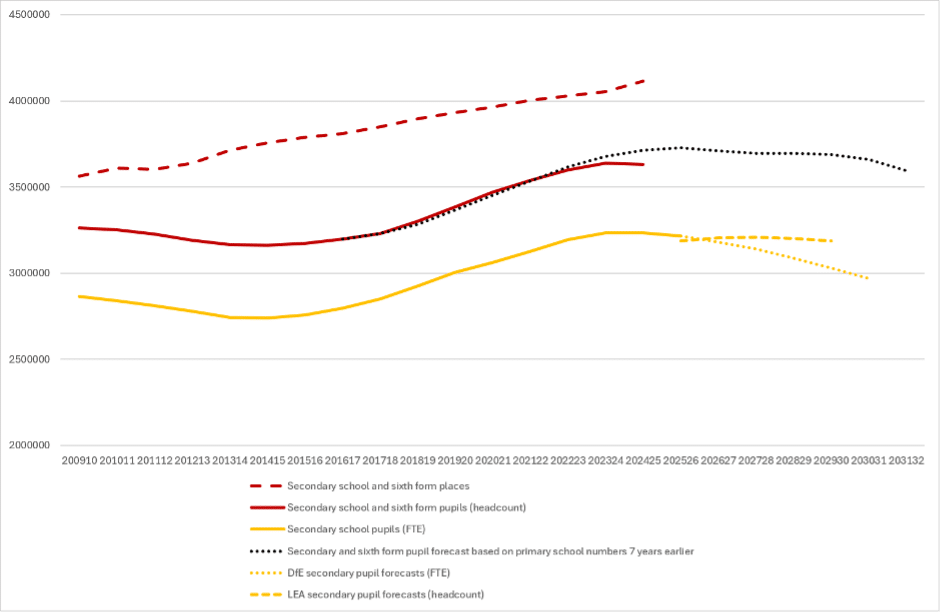
As such, not only are there significant levels of under-occupation at present – which is undermining the financial viability of many existing schools – but this is also likely to become more prevalent in the coming years.
Notwithstanding this, there will be variation from area to area, with an existing or forecast shortfall of places in a proportion schools. This will need to be planned for and addressed whilst being careful not to further jeopardise the viability of existing schools. In order to do so, it is necessary to identify those areas in which there will need for additional places.
What guidance have MHCLG and DfE provided on how LEAs should assess the need for additional school places?
In this context, the MHCLG and the DfE have published guidance which provides clarity as to how LEAs should assess whether there is a need for additional school places to support planned developments. In very summary terms, the guidance sets out that:
- The capacity of school places should be assessed across a school place planning area, which are areas defined by LEAs and agreed with the DfE to represent ‘schools located in close proximity, and which pupils could reasonably attend’. However, in certain instances it may be appropriate to consider capacity over different areas including for example:
- Where a development generates a need for an onsite primary school, in which case the capacity of schools beyond a reasonable and safe walking distance need not be considered.
- Where pupils may reasonably attend schools in other school place planning areas.
- Where planning areas are of a size or configuration which prevents some of the schools from being reasonable alternatives.
- The number of school places should be calculated using the Pupil Admission Number (PAN), unless the built capacity is far in excess of the PAN.
- The DfE apply a 2% operating margin (i.e. a 98% occupancy rate) to help support parental choice, churn in the pupil population and the general manageability of the system, but LEAs may apply a different operating margin where they have evidence and reasoning to do so.
- The forecast number of pupils at the time a development is expected to be built should be assessed to determine the extent to which existing schools will have capacity to accommodate the pupils arising from the proposed development.
- Pupil numbers arising from a development should be calculated using pupil yield rates. The DfE recommends using its nationally derived pupil yields, based comprehensive research it has undertaken on developments of 10 or more dwellings between 2008 and 2022. That is unless there is more detailed and representative data over a longer period of data showing a significant recent deviation from historic trends.
- The DfE’s pupil yields do not account for the local movement of families. This will inevitably mean that the net change in pupil numbers is lower than suggested by the DfE’s pupil yields. LEAs may adjust for this where they have the evidence to do so.
Assessing whether additional school places are needed to support new development relies at least in part on the pupil forecasts of LEAs. These forecasts and their accuracy are the focus of this article.
Additional school places are being assessed on the basis of forecasts that significantly overestimate the number of arising pupils
Whilst the accuracy of the pupil forecasts prepared by LEAs varies, at least in aggregate, these significantly over-estimate the number of pupils arising.
Indeed, the DfE publishes scorecards annually, which compare the number of pupils previously forecast with the number that has actually arisen over the first year and the first three years of the forecast period. The latest scorecard identifies that the forecasts have over-estimated the number of pupils arising as illustrated in the following table.
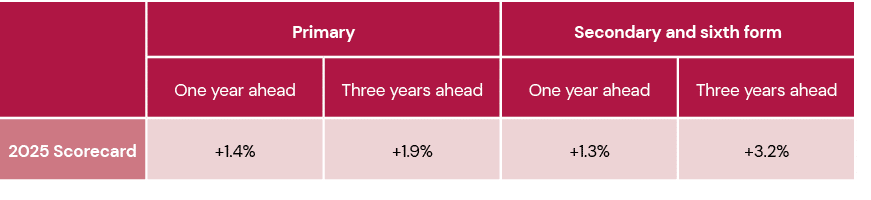
Whilst forecasts with an over-estimation of 1.9% to 3.2% over a three-year period may be considered accurate with an appropriate degree of tolerance, it should not be forgotten that:
- An over-estimation of 1.9% of primary school pupils represents 81k pupils who will not arise but for whom places may be needed. This is equivalent to an over-estimation of a need for 194 primary schools with 2 forms of entry.
- An over-estimation of 3.2% of secondary school and sixth form pupils represents 120k pupils who will not arise but for whom places may be needed. This is equivalent to an over-estimation of a need for 161 secondary schools, including sixth forms with 4 forms of entry.
This is all in the context of the already undesirable situation in which there are a significant number of unoccupied school places which may be jeopardising the viability of existing schools.
This is compounded by that some LEAs add pupils assumed to arise from proposed developments to their SCAP forecasts when assessing the need for additional school places. Consequently, decisions are being based on projections that exceed the SCAP forecasts, which themselves overestimate future pupil numbers in aggregate.
As such, at least in a number of the LEAs in which Pegasus Group has been involved, the need for additional school places is being assessed on the basis of forecasts which significantly over-estimate the number of pupils arising.
The relationship between the number of homes built and pupils arising
One of the reasons forecasts may overestimate pupils arising is that it is often assumed that where new homes are built, this will necessarily give rise to an increased demand for school places. Whilst this may intuitively feel correct, closer scrutiny reveals that this is not in fact the case.
The development of homes will not affect the existing number of pupils resident in the country, nor will it increase the levels of net international migration. As such, at least at a national scale, the delivery of homes will have no effect on pupil numbers. Indeed, this is evident from the fact that the pupil population of the country has remained relatively stable over many years, notwithstanding the fact that a significant number of homes have been built. By way of example, the number of primary school pupils in mainstream schools has changed from 4.44M in 2018/19 to 4.40M by 2024/25, despite that 1.4M homes were built from 2019-25.
The development of homes may, however, influence internal migration flows, resulting in a greater number of pupils in one locality and a corresponding reduction in others. Consequently, in order to maintain existing pupil numbers, enough development needs to occur in each locality to encourage a sufficient number of pupils to move to the area to offset the pupils that will move out of the area to developments elsewhere.
If there are insufficient levels of development, it would be expected that pupil numbers will reduce potentially to the detriment of the viability of existing schools. By contrast, where the levels of development are of a sufficient scale to increase pupil numbers, this may necessitate the provision of additional school places, depending on the capacity of existing schools to accommodate the additional pupils.
However, the reducing number of pupils that would occur with insufficient levels of development is often not accounted for within the pupil forecasts of LEAs. Indeed, many LEAs assume that historic admission rates, migration rates, and cohort progression rates will persist regardless of the rates of development. This means that pupil forecasts may implicitly assume that the rates which arose as a consequence, ofr previous rates of housing delivery, will persist in spite of those rates of development not being delivered in the future.
Similarly, many LEAs then add on the pupils arising from all housing developments to the pupil forecasts, notwithstanding that a proportion of this development will be needed just to maintain historic rates, which again serves to over-estimate the number of pupils arising.
This over-estimation within the forecasts of LEAs is underlined by the preceding charts. The forecasts of LEAs that do not account for the redistribution of pupils nationally suggest that there will be significantly more pupils than the forecasts of the DfE which do account for this. Indeed, the DfE’s forecasts suggest that the number of primary school pupils will reduce by 9% from 2025/26 to 2029/30, while the LEA’s forecasts suggest that it will only reduced by 4%. The DfE’s forecasts suggest that the number of secondary and sixth-form pupils will decrease by 6%, whereas the LEAs suggest that it will remain broadly static.
The consequences of overestimating the number of pupils and school places
As the need for school places is often calculated by LEAs on the basis of forecasts that over-estimate the number of pupils, far more school places have been funded and delivered than are needed. As a result, the number of unoccupied school places has and will continue to increase.
As the amount of funding schools receive is determined based on the number of pupils they accommodate, this over-estimation has placed significant viability challenges on a large proportion of schools nationally. Indeed, almost a quarter of schools are already at significant financial risk, owing to the number of unoccupied places in them.
Furthermore, not only does the provision of unnecessary school places undermine the viability of a proportion of existing schools, but it also places a further financial constraint on the viability of residential developments, which are already struggling in many parts of England.
The remedy is nationally coordinated pupil forecasts
In many LEAs, pupil forecasts are robust and it would be appropriate to continue to rely upon these. However, in others this is far from the case.
To help address the challenges of existing schools becoming unviable, as well as the viability challenges facing the housebuilding industry, it would be helpful if a single set of co-ordinated pupil forecasts for each school place planning area was prepared by the DfE. These should be tied to the national pupil forecasts of the DfE and should then be used to inform the need for additional school places to serve the forecast population and the need arising from proposed developments. This would provide a more consistent and robust evidence base than the current approach, whereby each LEA adopts different methodologies that demonstrably over-exaggerate pupil numbers in aggregate.

Want to discuss an education project?
Reach out to to learn more about how we can support you. Pegasus’ multidisciplinary services are also available to education projects via the following public sector frameworks: GCA Construction Professional Services 2 (RM6356) and ESPO 2700_26 Estates Management Professional Services.